Breast Surgery · Abu Dhabi & Dubai
Breast Implants — Types, Safety & Longevity
Modern breast implants are cohesive silicone gel devices, chosen by measurement rather than cup size — round, anatomical or ergonomic, in different profiles. They are long-term devices, not lifetime ones, and there is no rule to replace them every ten years. This is the honest guide Dr. Paulo Michels gives patients in Abu Dhabi, Dubai and across the UAE.
- {{ic-shield}}Modern low-risk
surfaces - {{ic-wave}}Measured &
3D-planned - {{ic-heart}}Honest
evidence
Overview
What are breast implants?
Breast implants are soft devices filled with cohesive silicone gel inside a durable multi-layer shell, placed behind the breast tissue or the chest muscle to restore or add volume. They are the engine of breast augmentation and of a breast lift with implants, and one of the most studied medical devices in the world.
Implants are measured in cubic centimetres (cc), not cup sizes — as a rough guide, 150–200 cc is about one cup size, though it varies with your frame. The right implant is chosen to fit you: your chest width, your breast footprint and your tissue — never the reverse.
Modern cohesive gel holds its shape even if the shell is compromised, and today’s shells are considerably more durable than the devices of the 1990s — the reason so much of what people “know” about implants is out of date.
The choices
What types of breast implant are there?
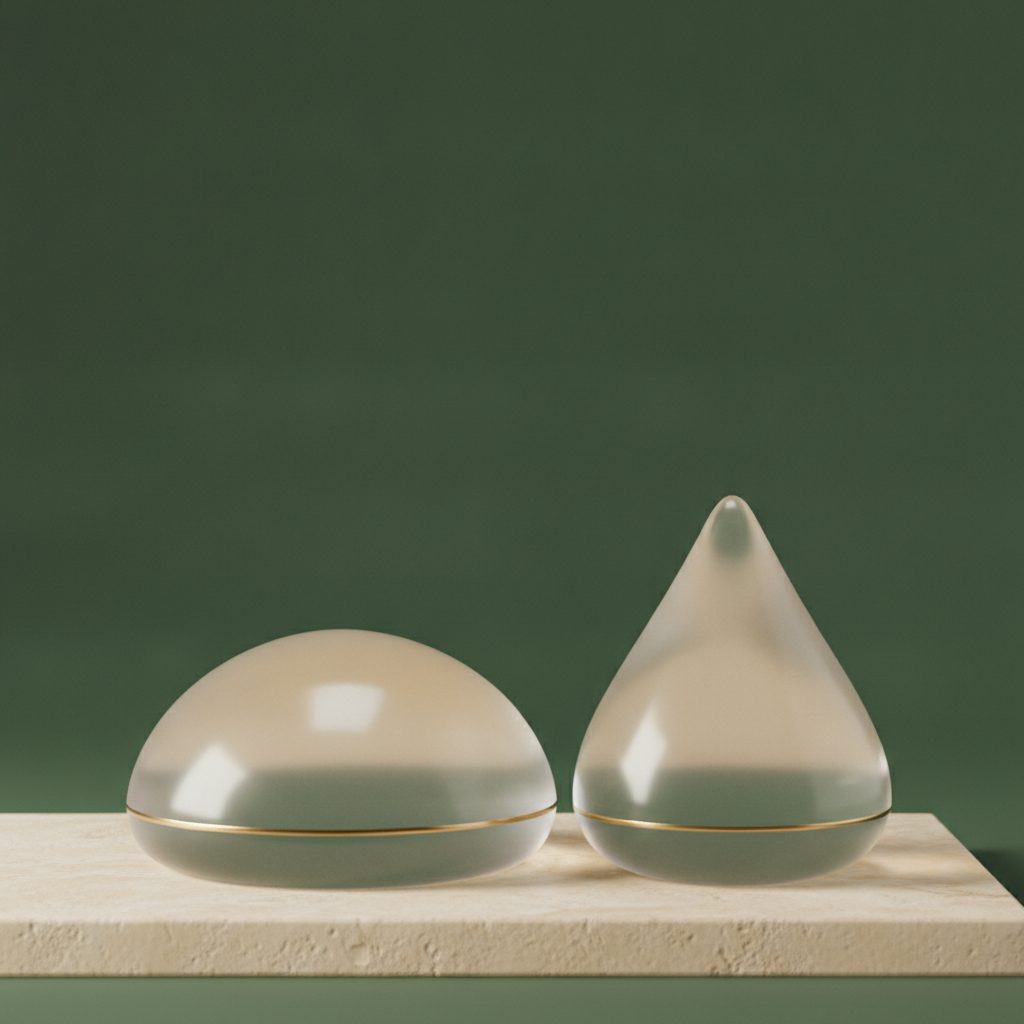
Three shapes and three profiles — each excellent in the right patient, chosen against your measured anatomy, never by fashion.
Round
More upper-pole fullness, and it cannot rotate — a forgiving, reliable choice for many patients.
Anatomical (teardrop)
Mimics the natural slope of the breast, fuller below than above. Needs precise pocket control to stay oriented.
Ergonomic
Behaves like a teardrop upright and a round lying down — following gravity the way natural tissue does.
Each shape comes in low, moderate and high profiles — how far it projects on a given base width, matched to your chest at consultation. The implant surface is part of the safety conversation (below). Dr. Paulo Michels works only with modern, low-risk surfaces and explains the evidence for each at consultation.
The method
How is the right implant chosen?
By measurement, not guesswork. Your breast base width is the single most important number — an implant wider than your breast footprint produces visible edges and side fullness. Soft-tissue pinch thickness determines the safest plane, and skin stretch and nipple-to-fold distance complete the picture.
3D simulation then previews different volumes and profiles on your own body, from every angle — instead of imagining “325 cc”, you see it. This is what makes the size decision shared and confident, and it dramatically reduces the commonest regret in augmentation worldwide: a size that was never right.
The full surgical method — the dual-plane pocket, the internal bra and the fast-recovery protocol — is explained on the breast augmentation page.
The honest, complete answer
Are breast implants safe?
Breast augmentation is one of the most studied operations in medicine, with decades of published data. These are the honest numbers — reviewed personally at consultation and documented in bilingual English–Arabic informed consent.
Published rates
Surgical & implant risks
- Hematoma (bleeding around the implant) — around 1% in published series; treated promptly
- Infection — roughly 1% in primary aesthetic augmentation
- Capsular contracture — modern surfaces show published rates around 1% vs historic rates above 10%
- Rupture — modern cohesive gel ruptures rarely (well under 1% per year); often silent, which is why surveillance matters
- Rippling / visibility — mainly in very thin patients; reduced by dual plane and hybrid fat
- Malposition (bottoming out, drift) — countered structurally by the internal bra
The rare, important conversations
BIA-ALCL & BII
BIA-ALCL is a rare, highly treatable lymphoma of the capsule associated overwhelmingly with textured implants (estimates roughly 1 in 2,200 to 1 in 86,000 textured-implant patients); the ASPS notes no confirmed cases involving only smooth implants. Surface choice and this evidence are reviewed openly with every patient.
Breast implant illness (BII) describes systemic symptoms some women attribute to implants. It is not a formally defined disease and research is ongoing, but the FDA requires it in informed consent, and Dr. Paulo Michels treats it as a legitimate conversation — including that most patients who choose removal report symptom improvement.
Implants do not cause breast cancer or prevent its detection — mammography continues with implant-displacement (Eklund) views, and screening schedules are unchanged.
The 10-year myth
How long do breast implants last?
The “replace every 10 years” rule is a myth — there is no medical requirement to exchange implants on a schedule. Modern implants are exchanged only for a reason: a rupture, a hardening capsule, a change in your own tissue, or a wish to change size or remove them. Many women keep the same implants comfortably for 15–20 years or more.
What decides longevity in practice: the implant generation (today’s devices are built to far higher standards), capsular contracture in a small minority, your own tissue — pregnancy, weight change and ageing keep reshaping the breast around the implant — and surgical technique, since a precise pocket and long-term support reduce the malposition that drives many re-operations.
Surveillance
How are breast implants monitored?
Implants are not lifetime devices, so they are monitored rather than forgotten. For silicone implants, FDA guidance recommends periodic imaging — ultrasound or MRI — starting around 5–6 years after surgery and every 2–3 years thereafter, because a cohesive-gel rupture can be silent. Any change in shape, size or feel earns an ultrasound at any time.
Keep your implant card — the record of make, model and serial number — as it makes any future review far simpler. If your surgery was years ago and nothing has ever been scanned, that is a reason to start now, not to worry.
When to be seen
What are the signs an implant should be reviewed?
None of these automatically means surgery — but all of them deserve an examination:
- A change in the shape, size or position of one or both breasts
- New firmness or hardening, or a breast that simply feels different
- Pain, swelling or a lump in the breast or the armpit
- Visible rippling, wrinkling or an implant edge you could not see before
- A significant impact or injury to the breast — a check is sensible even if everything looks normal
Built to hold
What keeps an implant stable for years?
The implant is only half the story — how it is supported decides whether the result still looks right at ten years.
The internal bra
Advanced internal suturing that reinforces the inframammary fold and the lower pocket with your own tissue, creating a supportive shelf that holds the implant in its planned position. It structurally reduces bottoming out and lateral drift — two of the commonest reasons for revision worldwide.
The dual-plane pocket
The upper part of the implant sits under the pectoralis muscle, the lower part behind the breast tissue — muscle camouflage where the implant needs it, natural shaping where the breast needs it. It also protects against visibility and rippling in thinner tissue.
The honest boundary
Implant, lift, or both?
An implant adds volume — it cannot lift a sagging breast. If the nipple sits at or below the fold when standing, forcing an implant alone produces a heavy, low result. Sagging with good volume points to a breast lift (mastopexy); a breast that is both sagging and deflated points to a breast lift with implants, usually as a single operation. The mirror test with measurements decides it honestly at consultation.
See your result before you decide anything
Book a 3D planning consultation with Dr. Paulo Michels — measured, simulated and honest, so the implant decision is yours and clear.
FAQ
Breast implants, answered
Do breast implants need replacing every ten years?
No — this is one of the most persistent myths in aesthetic surgery. Implants are exchanged only for a reason: a rupture, a hardening capsule, a change in your tissue, or a change in what you want. An implant that is behaving perfectly is monitored, not replaced.
How long do breast implants actually last?
Modern cohesive silicone implants often remain in excellent condition for 15–20 years or more. Think of them as long-term devices, not lifetime ones: plan for periodic imaging, and accept that at some point in the decades ahead you may choose — or need — a revision.
How are silicone implants monitored?
FDA guidance recommends ultrasound or MRI starting around 5–6 years after surgery and every 2–3 years thereafter, because silicone ruptures can be silent. Any change in shape, size or feel earns an ultrasound at any time.
Can an implant rupture without me noticing?
Yes — a modern cohesive-gel rupture can be silent: the gel stays in place and nothing looks or feels different. That is precisely why routine imaging exists. Saline implants, by contrast, deflate visibly within days.
Do breast implants cause breast cancer?
No — implants do not cause breast cancer or prevent its detection, and screening schedules are unchanged (radiologists use implant-displacement views). BIA-ALCL is a separate, rare, highly treatable lymphoma of the capsule associated overwhelmingly with textured implants — the evidence and surface choice are discussed openly at consultation.
Round or teardrop — which is better?
Both are excellent in the right patient. Round gives more upper-pole fullness and cannot rotate; anatomical mimics the natural teardrop but needs precise pocket control; ergonomic implants behave like a teardrop upright and a round lying down. The choice follows your anatomy and goals.
Can I breastfeed with implants?
Most women breastfeed normally. The inframammary incision avoids the gland and ducts, and dual-plane placement puts the implant behind — not inside — the breast tissue.
I had my implants placed abroad — can they be checked in the UAE?
Yes. Dr. Paulo Michels examines and monitors implants placed elsewhere at Elyzee Hospital in Abu Dhabi — a frequent request in a country where many residents had surgery abroad. Bring your implant card if you have it; patients come from Dubai and across the UAE.
Enquiry
Ask about Breast Implants
Leave your details and Dr. Paulo Michels’ team will reply personally — or message on WhatsApp.